
If you can no longer keep paying for a pre-selling condo, you have two realistic exits: cancel and claim a refund under the Maceda Law, or let someone assume your unit and reimburse you. Which one recovers more money depends on how much you have paid, how your developer reads the law, and what the assumption will cost your buyer.
Many buyers reserve a unit with a small monthly down payment, often while working abroad. Then plans change: a job ends, a family need comes up, or the large balance due at turnover starts to look out of reach. The usual first instinct is to stop paying and ask for a refund. That is often the most expensive mistake a buyer can make.
This guide explains both exits in plain terms, so you can make the call before you miss a payment.
What the Maceda Law gives you
The Maceda Law (Republic Act No. 6552) protects buyers who pay for residential real estate in installments, including condominium units. Your rights depend on one line: whether you have paid at least two years of installments.
| Paid at least 2 years of installments | Paid less than 2 years | |
| Grace period | 1 month for every year of installments paid, without interest (usable once every 5 years) | At least 60 days from the missed due date |
| Refund if cancelled | Cash surrender value of 50% of total payments, plus 5% per year after the 5th year, up to 90% | None under the law (check your contract) |
| How the seller cancels | Notarial notice of cancellation, effective 30 days after you receive it, and only upon full payment of the cash surrender value | Notarial notice of cancellation, effective 30 days after you receive it |
Three points buyers often miss:
- Down payments and deposits count. The law includes them when counting the installments you have paid.
- No refund, no valid cancellation. For buyers past the two-year line, the cancellation does not take effect until the cash surrender value is actually paid. (plus a notarized and received notice)
- You cannot sign these rights away. Any contract clause or form that waives your Maceda rights is void.
The catch: how some developers count “two years”
You may have paid your monthly down payment for three or four years and still be told you are not entitled to any refund. Some developers do not count the installments you actually paid. Instead, they compute a hypothetical monthly amount and require 24 months of that.
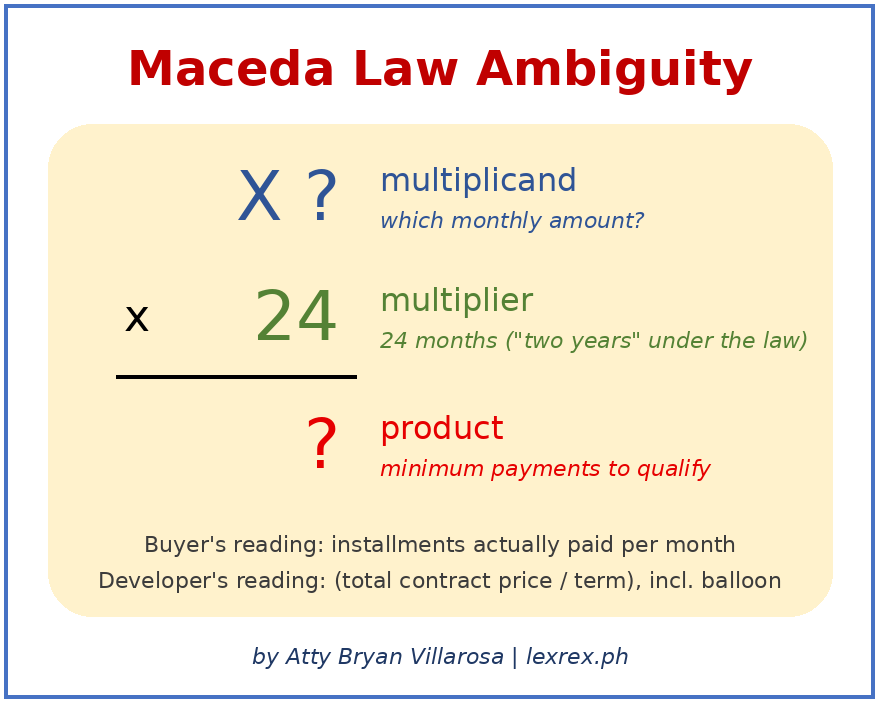
One formula we have seen in practice works like this:
- Take the entire total contract price, including the large balance due at turnover.
- Divide it by the number of months that would be used if it were put under in-house financing.
- Multiply the result by 24. That becomes the amount you supposedly must have paid.
For a unit with a total contract price of about ₱2.4 million on a 48-month down payment plan, that produces a requirement of roughly ₱1.17 million. A buyer paying a ₱4,700 monthly down payment would pay only about ₱240,000 in total before turnover. Under that formula, the buyer never qualifies, no matter how faithfully they paid.
We believe this reading is open to challenge. The law speaks of installments paid, and it expressly counts down payments and deposits. Your own term sheet fixes what each installment is. A formula that makes a refund impossible for an entire class of buyers runs against a law meant to protect them, and the law voids stipulations that defeat its protections. Disputes like this can be brought before the Human Settlements Adjudication Commission (HSAC).
The practical problem is cost and time. A case may take months, which is why many buyers are better served by the second exit.
The second exit: assumption
In an assumption, a new buyer takes over your unit, reimburses some or all of what you paid, and continues the payments under their own name. Section 5 of the Maceda Law gives you the right to sell or assign your rights before the contract is actually cancelled, through a notarized deed.
The law gives you the right, but the developer controls the paperwork. Developers typically require the following before approving an assumption:
- A clean account. Your statement of account must show no arrears. If turnover is near, the new buyer may have to pay the entire remaining down payment upfront.
- A bank-ready buyer. Many developers require the new buyer’s bank loan pre-approval or letter of guarantee, sometimes within a tight window of a few weeks.
- A redocumentation fee. Fees around ₱100,000 to ₱300,000 per unit are common, on top of a fresh reservation fee at current rates and reimbursement of taxes the developer already paid.
- Your notarized quitclaim releasing your rights to the unit.
- Special powers of attorney. If you or your buyer are abroad, expect SPAs in the developer’s and the bank’s own formats, apostilled or consularized.
Those costs fall on someone. If your buyer must pay ₱100,000 to the developer, they will expect to pay you that much less. Get the developer’s exact fees and requirements in writing before you set a price.
Pricing an assumption realistically
Your asking price sits between two numbers: what you would recover by walking away, and how much the new buyer saves compared with buying a new unit today.
- Find your floor. This is your realistic refund if you cancel. If your developer applies a formula that leaves you with nothing, your floor is close to zero, and any net amount beats letting the unit lapse.
- Find the buyer’s savings. Compare your original contract price with the developer’s current price for a similar unit. Add the transfer charges a new buyer would pay. Subtract the redocumentation and reservation fees the assuming buyer must shoulder.
- Price inside that gap. If the developer’s prices have risen since you reserved, you may ask for full reimbursement or even a small premium. If prices are flat, expect to accept less than you paid.
- Match the buyer pool. A unit with a large balance due soon needs a buyer who can get a bank loan quickly. A unit with a long, low monthly down payment left suits overseas workers and small investors.
Set a deadline. A unit that sits unsold while you keep paying only grows your loss if you end up cancelling.
Mistakes that cost buyers money
- Stopping payments before deciding. A delinquent account usually cannot be assumed, and a developer that says you have not reached two years may cancel after a short grace period with nothing returned.
- Signing a “voluntary cancellation” form. Some forms include a waiver of your refund or an admission about your payment history. Have it reviewed before you sign.
- Relying on verbal answers. Ask for the refund computation, the assumption fees and the requirements in writing. Written answers become evidence if a dispute follows.
- Pricing without knowing the fees. A ₱100,000 redocumentation fee can erase most of what a buyer is willing to pay you.
- Forgetting the paperwork abroad. If you are an overseas Filipino, your SPA must be apostilled or consularized. Start early, because it can take weeks.
How Villarosa Law Office can help
We help condo and house-and-lot buyers decide between a refund and an assumption, then carry out the choice. Atty. Bryan Alvin Rommel Y. Villarosa is a Philippine lawyer and an Accredited Real Estate Salesperson, so we look at both the legal position and the market reality of your unit.
Our services include:
- Maceda Law eligibility assessment. We review your reservation agreement, term sheet, contract to sell and statement of account, and compute your grace period and cash surrender value.
- Response to the developer’s computation. If you are told you are not entitled to a refund, we assess whether that position holds and prepare a written demand where warranted.
- Assumption assistance. Pricing guidance, the deed of assignment, quitclaim and SPAs, and coordination with the developer’s requirements.
- Support for overseas buyers. SPA preparation and instructions for apostille or consular processing, so you can act without flying home.
If you are deciding what to do with a pre-selling unit, contact us before you miss your next payment. Email at************@***il.com or message +63 908 812 8227 (Whatsapp/Viber). Our office is at 2F Capitol Subdivision, Inc. Building, 16th and Lacson Streets, Bacolod City, and we handle consultations online for clients anywhere.
This article provides general information and is not legal advice. Outcomes depend on the specific contract, payment history and developer policy in each case.