
A guide to SEC, BIR, and Mayor’s Permit registration
Every founder we sit down with starts the same way: “I just need help with the paperwork.”
By the end of the first meeting, the paperwork is rarely the problem. The problem is that registration touches four separate government agencies — SEC or DTI, BIR, the LGU, SSS/PhilHealth/PAGIBIG, DOLE and maybe FDA, IPOPHL, DHSUD, or BSP — and each one only sees its own slice of the business.
Nobody at any single window is checking whether your corporate name, your BIR line of business, your trademark filing, and your Mayor’s Permit all describe the same company the same way. If they don’t, you don’t find out today. You find out eighteen months from now, when a bank, an investor, or a regulator asks a question your paperwork can’t answer consistently.
This guide walks through the registration process as it actually runs in 2026 — starting with the step most founders leave for last: the Mayor’s Permit.
First, Choose the Right Vehicle
Before any of the steps below, decide what you’re registering. This decision is harder to undo than most founders expect, so it’s worth getting right the first time.
One Person Corporation (OPC). The default choice for a solo founder who wants the limited liability of a corporation without bringing in co-owners. You get a separate legal personality — your personal assets are shielded from the company’s obligations — while retaining full control. The tradeoffs are structural: an OPC has no board of directors, so certain actions require a written resolution of the single stockholder recorded in a Minutes Book instead of board minutes, and the single stockholder cannot simultaneously serve as the corporate secretary. These aren’t minor technicalities — we’ve seen OPC filings held up because a founder didn’t realize this rule applied to them.
Partnership. Two or more people pooling capital, skill, or both, with the flexibility to define profit-sharing and management however the partners agree. The catch: in an ordinary partnership, the partners’ personal liability isn’t automatically limited the way a corporation’s is. Worth choosing deliberately, not by default, and worth documenting the partners’ respective roles and exit terms before the business needs them.
Closed Corporation. For founders who want a small, tightly-held ownership group — often family businesses or a handful of co-founders — with restrictions on transferring shares to outsiders. It behaves more like a corporation than a partnership, but with contractual control over who can become an owner. Best suited to businesses that expect to stay small in headcount of owners, even if they grow large in operations.
If you’re not sure which fits, that’s the first conversation to have with counsel — not the SEC.
The Registration Sequence
Once the vehicle is chosen, registration runs roughly in this order: SEC (or DTI) → BIR → Local Government Unit (Mayor’s Permit) →, where relevant, IPOPHL for your brand. Skipping ahead — for instance, operating before the LGU leg is complete — is one of the most common and most avoidable compliance gaps we encounter.
The Mayor’s Permit — Bacolod City’s BPLO Process
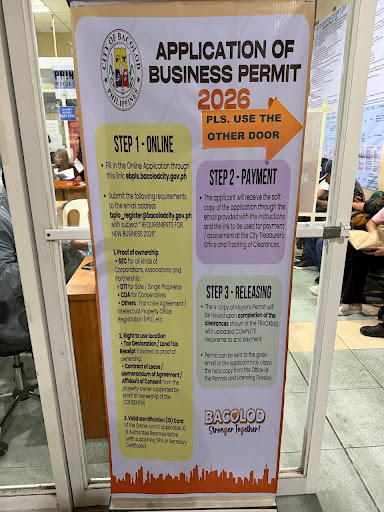
In Bacolod City, new business registration runs through the Business Permits and Licensing Office (BPLO), and as of 2026 it’s handled online.
Step 1 — Online Application and Requirements
Apply through the Bacolod City eBPLS portal at ebpls.bacolodcity.gov.ph, then email your complete documentary requirements to bp***********@*************ov.ph, using the subject line format REQUIREMENTS FOR NEW BUSINESS 2026 (adjusted to the current application cycle year).
You’ll need:
- Proof of registration — SEC Registration for corporations, partnerships, and associations; DTI Registration for sole proprietorships; CDA Registration for cooperatives; and, where applicable, a Franchise Agreement or IPOPHL registration.
- Proof of right to use your business address — if you own the property, your Tax Declaration, Land Tax Receipt, or Building Permit; if you lease, your Contract of Lease or a Memorandum of Agreement, or an Affidavit of Consent from the property owner together with the owner’s own proof of ownership.
- Valid identification — a government-issued ID of the business owner, or, if a representative is filing on the owner’s behalf, the representative’s ID together with a Special Power of Attorney or Secretary’s Certificate authorizing them to act.
Step 2 — Assessment and Payment
Once your submission is verified, BPLO emails you a soft copy of your application along with instructions and a link to track your clearances and settle payment through the City Treasurer’s Office.
Step 3 — Clearances and Release
Clearances are tracked through the same online system. Once all clearances are complete and payment is settled, your e-copy of the Mayor’s Permit is issued — sent to your registered email, or available for pickup as a hard copy at the BPLO office.
One detail worth flagging: if you don’t yet have a Tax Declaration for your business address, that’s a separate errand at the City Assessor’s Office, and it needs to happen before BPLO can process your address proof — not something to discover mid-application.
What the Forms Don’t Warn You About
Here’s what a registration checklist can’t tell you, because it isn’t designed to: each of these agencies only validates its own filing. SEC checks your Articles of Incorporation. BIR checks your tax registration. LGU checks your local business proof. None of them cross-checks against the others.
In practice, this is where business owners lose money and time:
- Mismatch: The name of the partnership in the SEC registration does not align with LGU and BIR registration.
- Entity-size misclassification. Startups are almost always “Small Entities” for fee purposes at BIR and IPOPHL, but registration systems don’t always default correctly — and the fee difference between small- and big-entity rates, compounded across multiple filings, can run into tens of thousands of pesos in avoidable overpayment.
- A corporate name that doesn’t match itself. Your SEC-registered name, your BIR registration, your trademark filing, and your contracts should all say the exact same thing.
- Missing tax types. A Certificate of Registration should cover the correct tax types, even though “substance over form” matters – having correct tax types in your COR supports business continuity.
- A trademark filed under the wrong entity name, or a specification of goods and services that promises more (or less) than the business actually does — both of which become expensive to fix after the fact, and cheap to get right the first time.
None of these may show up on a checklist of an agency. They show up when a bank asks a question, when a partner runs due diligence, or when a regulator sends a letter you weren’t expecting.
Why a Retainer, Not a One-Time Filing
Registration is a single event. Running a compliant company is not.
The founders who come back to us after a registration usually need the same three things: someone to make sure there is legal compliance before it becomes a liability, someone to draft the contracts (notarized employment/contractor agreements, NDAs, vendor terms) that the registration process never asks about, and someone who already knows their corporate structure enough to answer questions.
That’s the case for a monthly retainer over a one-off engagement, especially for a partnership or a closed corporation in its first year: contract review and drafting, corporate governance and SEC compliance touchpoints, data privacy foundations, notarized documents, and a lawyer who’s already inside your structure when something urgent comes up — instead of one meeting you for the first time in a crisis.
If you’re incorporating, about to incorporate, or already incorporated and unsure whether every leg of your registration actually landed — that’s exactly the conversation worth having before the next filing deadline, not after.
Villarosa Law Office advises founders and startups across Bacolod City and Negros Occidental on corporate formation, registration, labor law compliance, IP protection, and ongoing legal retainers — for One Person Corporations, partnerships, and closed corporations alike. Reach out through lexrex.ph to talk through which structure fits your business, or to set up a retainer before your next filing deadline.