
Every week, someone loses a property sale, a court hearing, or a bank release because a document was authenticated the wrong way abroad. Usually it is a Special Power of Attorney. Sometimes it is a birth certificate that was printed in 2011. Occasionally it is a foreign corporation’s board resolution that a Philippine agency simply refuses to accept.
This guide explains what an apostille actually is, when you need one, when you do not, and where the traps are. It is written for overseas Filipinos, foreign nationals with Philippine assets, and foreign entities transacting here.
What Is an Apostille?
An apostille is a standardized certificate that authenticates the origin of a public document so that it can be used in another country.
If you are a Filipino in a country abroad that is a Contracting Party to the Apostille Convention, and you want to execute an SPA or a particular covered document, the usual process is:
- Have the lawyer prepare the SPA.
- Avoid using generic SPAs online. Under Art. 1874 of the Civil Code, if the agent’s written authority is defective, a sale of land through that agent is void, not merely voidable. An apostille cannot save a badly drafted SPA.
- Sign and acknowledge it before a foreign notary public or other competent official.
- Obtain an apostille from the country’s designated Competent Authority
- Note that this is not issued by the notary public himself or herself.
- Purpose of the apostille: to authenticate the notary’s signature, capacity, and seal; it does not establish that the SPA was substantively drafted, was legally correct in the destination country, or that the attorney-in-fact has authority beyond what the SPA grants.
- If the country is not covered, or an exception applies: the document may require authentication through the appropriate Philippine establishment (e.g., consul). In some jurisdictions an intermediate certification is required before the competent authority will act, so confirm the local chain.
- Send the apostilled SPA to the Philippine attorney-in-fact.
Below is a sample Apostille certificate I assisted with for a client. It is a separate document attached to the document before they sent it to the Philippines. In many cases, this requires lawyer-to-lawyer coordination (a Philippine lawyer speaking with a foreign solicitor or notary public) to ensure accuracy.
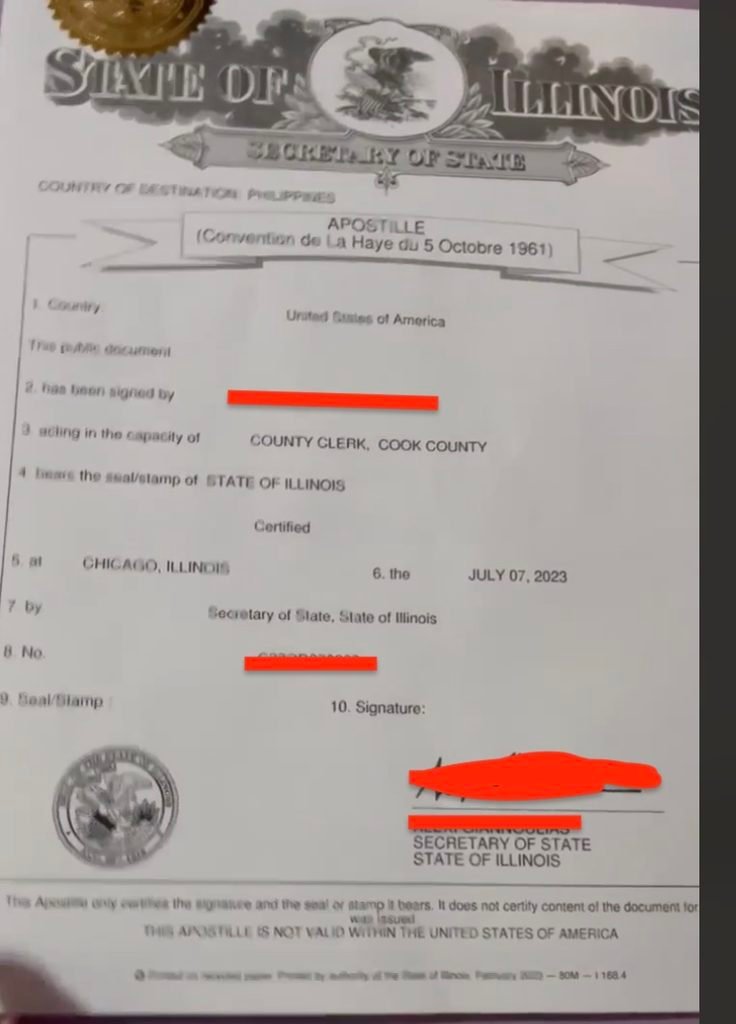
A Filipino abroad can skip #2 and #3 by going directly to a consular officer at the Philippine Embassy or Consulate General. Inside the Consulate/Embassy, they can “consularize” a document, which produces a Philippine notarial act that needs no apostille at all and is accepted without argument by agencies here, such as the Register of Deeds or Prosecutors.
Note that the receiving Philippine court, agency, bank, or other institution may impose additional requirements.
History and Purpose
An Apostille is issued under the Hague Convention of 5 October 1961 Abolishing the Requirement of Legalisation for Foreign Public Documents, commonly called the “Apostille Convention“.
Purpose of Apostille: confirms the authenticity of the signature on the document, the capacity in which the signatory acted, and the identity of any seal or stamp. It does not certify that the contents of the document are true, valid, or legally sufficient. An apostilled Special Power of Attorney can still be void if it was defectively drafted.
The Philippines became a party to the Apostille Convention on 14 May 2019.
Apostille vs. Red Ribbon: What Actually Changed in 2019
Before 2019, a Philippine document intended for use abroad had to pass through three layers:
- Certification by the issuing agency (PSA, LCR, school, court, or notary public).
- Authentication by the Department of Foreign Affairs, which affixed the familiar red satin ribbon.
- Consular legalization by the embassy or consulate of the destination country in Manila.
The third step was the expensive one. It required a physical appearance or a courier service, embassy fees, and waiting time measured in weeks.
Under the Apostille Convention, the consular legalization step is abolished between contracting states. A Philippine document apostilled by the DFA Office of Consular Affairs can be sent directly to the destination country. A foreign document apostilled by that country’s competent authority can be used in the Philippines without passing through the Philippine Embassy there.
Authentication was not abolished. It was replaced. The DFA is still the sole competent authority for Philippine documents, and the DFA does not apostille foreign-issued documents.
Which Countries Does the Philippine Apostille Not Cover?
Two categories fall outside the shortcut, and this is where most avoidable mistakes happen.
Non-contracting states. The Convention applies only when both the country of origin and the country of destination are parties. For non-member states, the old legalization route still governs.
States that objected to Philippine accession. Under Article 12 of the Convention, an existing contracting state may object to a new accession, in which case the Convention does not enter into force between those two states. Four countries objected to the Philippines: Austria, Finland, Germany, and Greece. Advisories and blog posts still circulating online repeat all four, but the list has shifted:
- Austria withdrew its objection effective 1 June 2023.
- Greece withdrew its objection effective 25 June 2024.
- Finland withdrew its objection effective 22 August 2025.
- Germany’s objection has not been withdrawn as of this writing, so Philippine documents intended for German use generally may still require legalization by the German Embassy in Manila, and vice versa.
Because this list changes, verify the current status on the HCCH status table and with the DFA before you pay for anything. Relying on a 2019 advisory in 2026 is how people end up with a useless certificate.
Do You Really Need an Apostille? The Distinction Most People Miss
Here is the single most misunderstood point in Philippine practice.
An apostille is designed for public documents. It is not automatically required for every document that happens to be signed or notarized abroad. Philippine evidence law draws the line clearly.
Foreign official or public records. Documents issued by a foreign government agency (a foreign birth certificate, a divorce decree, a court judgment, a company registration certificate) are governed by Rule 132, Section 24 of the Rules of Court, as amended by the 2019 Amendments to the Revised Rules on Evidence. If the issuing country is a party to an applicable treaty, the attestation must follow the form prescribed by that treaty, which for Apostille Convention states means an apostille. No further certificate is required where the treaty has abolished or exempted the formality.
Documents merely notarized abroad. A private instrument, such as a Special Power of Attorney or an affidavit, that is executed and notarized in a foreign country is not a foreign official record under Rule 132, Section 19(a). It is therefore not subject to the authentication requirement that applies to official records. A notarized document is generally self-authenticating as to its execution under Rule 132, Section 30. The Supreme Court applied this reasoning in Tujan-Militante v. Nustad (2017) and again in Anido v. Republic of the Philippines (2024).
That is the doctrine. Now the practical reality.
The SPA Trap: Why Your Notarized SPA May Still Be Rejected without an Apostille
This is where clients lose the most money, and it is worth being blunt about it.
Even though jurisprudence says a foreign-notarized SPA is self-authenticating as to execution, the Register of Deeds, the BIR, banks, the SEC, the LTO, and most government agencies are not courts. They apply internal circulars and checklists. In day-to-day practice, an SPA notarized abroad without an apostille is routinely refused at the counter.
The doctrinal argument is available to you in court. It is not a practical answer to a Registry of Deeds examiner who is looking for a certificate.
So the working rule for anyone selling, mortgaging, or transferring Philippine real property from abroad is this: get the apostille anyway. The cost of an apostille is trivial compared to a rejected transfer, a lapsed contract deadline, or a buyer who walks away.
How to Execute a Valid SPA from Abroad
Article 1878 of the Civil Code requires a special power of attorney for an agent to sell, mortgage, or otherwise dispose of immovable property. Article 1874 goes further: when a sale of land is made through an agent, the agent’s authority must be in writing, or the sale is void. Not voidable. Void.
Before 2019, a principal abroad had to travel to the nearest Philippine Embassy or Consulate to have the SPA consularized. For an OFW in a province eight hours from the nearest post, this meant lost wages and travel costs.
The current route in an Apostille country:
- Have the SPA drafted in the Philippines by Philippine counsel. This is the step people skip, and it is the step that matters most. The SPA must describe the property, the powers granted, and the transaction using Philippine registration language. A generic template downloaded online will be accepted by a foreign notary and then rejected by the Register of Deeds.
- Sign it before a local notary public in your country of residence, with valid identification.
- Have the notary’s signature apostilled by that country’s competent authority. In the United States this is the Secretary of State of the state where the notary is commissioned. In the UK it is the Foreign, Commonwealth and Development Office. In the UAE, Japan, Singapore, Canada, and Australia, the designated authority differs and should be confirmed.
- Courier the original to your attorney-in-fact in the Philippines. Do not laminate it, do not detach the apostille, do not staple anything over it. A separated or damaged apostille invites rejection.
- Have the SPA presented together with the required tax and registration documents. Some agencies also require a consularized or apostilled photocopy of the principal’s passport.
If you are in Germany, or in a non-Convention country, skip steps 3 and use consular legalization at the Philippine Embassy or Consulate instead.
PSA Documents: The Apostille Exception to the Permanent Validity Law
Republic Act No. 11909, the Permanent Validity of Certificates of Live Birth, Death and Marriage Act, established that PSA and local civil registrar certificates do not expire. Government agencies and private firms are prohibited from requiring citizens to obtain newer copies simply because the existing one was issued years ago.
There is one carve-out that OFWs run into constantly. Under Section 5 in relation to Rule 9 of the Implementing Rules, an end-user may still lawfully require a newly issued copy when the civil registry document is to be used abroad and requires an apostille.
The rationale is technical rather than bureaucratic. The DFA and foreign receiving authorities need a fresh security paper (SECPA) print with fully legible security features, barcodes, and verification markers. A 2009 copy with a faded barcode cannot be processed.
So if someone tells you your 2012 PSA birth certificate is “expired” for a local job application, they are wrong and you can say so. If the DFA asks for a fresh copy for apostille purposes, that is the exception operating exactly as written.
Foreign Bidders in Government Procurement
For foreign entities bidding on Philippine government contracts, the Implementing Rules of Republic Act No. 12009 (2025) set out the authentication route explicitly.
Foreign bidders may submit equivalent documents in English. Where the documents are not in English, they must be accompanied by an English translation issued by the relevant foreign government agency, an authorized translating agency, or a registered translator in the bidder’s country.
The documents must then be authenticated by the appropriate Philippine foreign service post, or, for countries covered by the Apostille Convention, through an apostille issued by that country’s competent authority, subject to any country-specific legalization requirement identified by the DFA.
The translation requirement is frequently overlooked and is a common ground for disqualification at eligibility screening.
Proving Foreign Documents in Philippine Court
Philippine courts do not take judicial notice of foreign law or foreign public records. Foreign law must be alleged and proved as a fact. This matters enormously in recognition of foreign divorce cases, foreign marriage validity disputes, estate proceedings with foreign heirs, and enforcement of foreign judgments.
The two-track rule under Rule 132, Section 24:
If the foreign country is an Apostille Convention state (and no objection is in force with the Philippines): the document must be attested by the officer with legal custody of the record and accompanied by an apostille from that country’s competent authority. Once compliant, it is admissible as prima facie evidence of due execution and genuineness without any Philippine consular signature.
If the foreign country is not covered: the traditional route applies. The document must be attested by the foreign custodian and accompanied by a certificate from a Philippine diplomatic or consular officer stationed in that country, authenticated by the seal of the office.
A separate and independent point: proving the foreign document is not the same as proving the foreign law behind it. In divorce recognition cases, petitioners routinely submit a perfectly apostilled divorce decree and still lose because they failed to prove the foreign divorce statute itself in the manner the Rules require.
Common and Expensive Mistakes
- Using an online SPA template. Foreign notaries do not screen for Philippine registrability. The Register of Deeds does.
- Apostilling a photocopy when the original is required, or the reverse.
- Assuming an apostille cures a substantive defect. An SPA signed by a principal who lacked capacity, or one that omits the specific power to sell, is defective no matter how many seals are on it.
- Sending a document to Germany with only an apostille.
- Letting the SPA go stale. Many banks and registries will not honor an SPA executed more than a year earlier without a fresh certification that the principal is alive and has not revoked it.
- Not preparing for the principal’s death. Agency is extinguished by the death of the principal. An SPA that arrives after the principal has died is worthless, and the transaction becomes an estate settlement matter.
- Forgetting the tax clock. Capital gains tax and documentary stamp tax deadlines run from the date of the deed, not from the date the SPA finally reaches Manila.
Frequently Asked Questions
Can the DFA apostille a foreign document? No. The DFA issues apostilles only for documents issued by Philippine authorities. A foreign document must be apostilled by the competent authority of its own country.
Can I apostille a document for use inside the Philippines? No. An apostille is by definition for use abroad. A document issued in the Philippines and used in the Philippines does not need one.
Is an apostilled SPA valid forever? Legally, an SPA has no fixed expiry unless one is stated in the instrument. In practice, many banks, registries, and agencies impose their own recency requirements, commonly six months to one year.
My SPA was notarized at the Philippine Embassy. Do I still need an apostille? No. A document notarized or acknowledged before a Philippine consular officer is treated as a Philippine notarial act and does not require an apostille for use here. This is often called as “consularized”
Can one SPA cover several properties and several transactions? Yes, if drafted properly. Whether that is wise is a different question. Broad authority in the wrong hands is a real risk, and I generally advise narrowing the powers and identifying the properties specifically.
How long does the whole process take? For a straightforward US or UAE-based SPA, typically two to four weeks from drafting to arrival in the Philippines, driven mostly by the foreign apostille queue and courier time.
When You Should Get Legal Advice Before Signing Anything
You should speak to Philippine counsel before executing the document, not after it is rejected, if any of the following apply:
- You are selling, mortgaging, or donating Philippine real property from abroad.
- You are a foreign national, or married to one, and the property is or may be conjugal or community property.
- The registered owner has died, or one of the co-owners has died.
- The title is a CLOA, a free patent, or otherwise carries restrictions.
- You are a foreign corporation and the signatory’s authority flows from a board resolution or a foreign secretary’s certificate.
- You need a foreign divorce, adoption, or judgment recognized in the Philippines.
- The transaction involves a deadline, a buyer’s deposit, or a bank release.
Consultation
Villarosa Law Office (LexRex Ph) prepares apostille-ready Special Powers of Attorney, General Powers of Attorney, deeds, affidavits, and secretary’s certificates drafted specifically for Philippine registration, together with step-by-step execution instructions tailored to your country of residence. We also handle the Philippine-side processing: BIR clearance, transfer, and registration through to the issuance of the new title.
Atty. Bryan Alvin Rommel Y. Villarosa Villarosa Law Office (LexRex Ph) 2F Capitol Subdivision, Inc. Building, 16th and Lacson Streets, Bacolod City, Negros Occidental Email: at************@***il.com Mobile / Viber / WhatsApp: +63 908 812 8227 Web: lexrex.ph
Consultations are available online for clients abroad. Please indicate your country of residence and the type of transaction so the correct authentication route can be confirmed before drafting begins.
This article is general legal information based on Philippine law as of September 2026 and does not create a lawyer-client relationship. Treaty status, agency circulars, and internal checklists change. Please obtain advice on your specific facts before signing or filing anything.