Quick answers:
- Maximum Amount: ₱1,000,000. (Rule IV Sec. 1 A.M. 08-8-7-SC)
- Do I need a lawyer? Lawyers are not allowed during the hearings, but they can help prepare your forms, organize your evidence, and coach you on what to say.
- Abroad/OFW? You can file by executing a Special Power of Attorney (SPA) assigning a representative in the Philippines.
What cases fall under Small Claims in the Philippines?
For a case to be filed as a Small Claims case, it must be strictly or purely civil in nature. Meaning, it should involve only an action seeking payment or reimbursement of a sum of money, where the value of the claim does not exceed P1,000,000. (This is a new threshold under A.M 08-8-7-SC to cover bigger debts [11 April 2022])
If your claim has an accompanying criminal aspect, it falls outside the coverage of the Rule on Small Claims.
Eligible causes of action are: Unpaid debts, credit card debts, small-scale loans, unpaid rent, or broken contracts.
If the cause of action involves only the civil aspect of Batas Pambansa Blg. 22 (the Bouncing Checks Law) and no criminal action has been instituted therefor, the case shall be tried under the Rules on Summary Procedure. If a criminal action is instituted for the same B.P. 22 violation, the civil aspect must be consolidated with the criminal action so they can be tried and decided jointly under the Rule on Summary Procedure.
Why are lawyers not allowed in small claims hearings?
Lawyers are prohibited from appearing in small claims cases to keep the proceedings simple, informal, fast, and inexpensive.
Through self-representation, ordinary individuals, especially low-income earners, will be encouraged to pursue or defend claims without the burden of attorney’s fees and procedural technicalities.
However, parties can always reach out to a lawyer for advice or assistance outside the court (either before or after the hearing).
Furthermore, if the judge determines that a party cannot properly present their claim or defense and needs assistance, the court has the discretion to allow another individual (provided they are not an attorney) to assist that party. Exception to the exception: If the lawyer themself is the party.
How a Lawyer CAN Help You Win a Small Claims Case
(Note: Before filing a small claims case, make sure you have already sent a factually and legally sound Final Demand Letter)
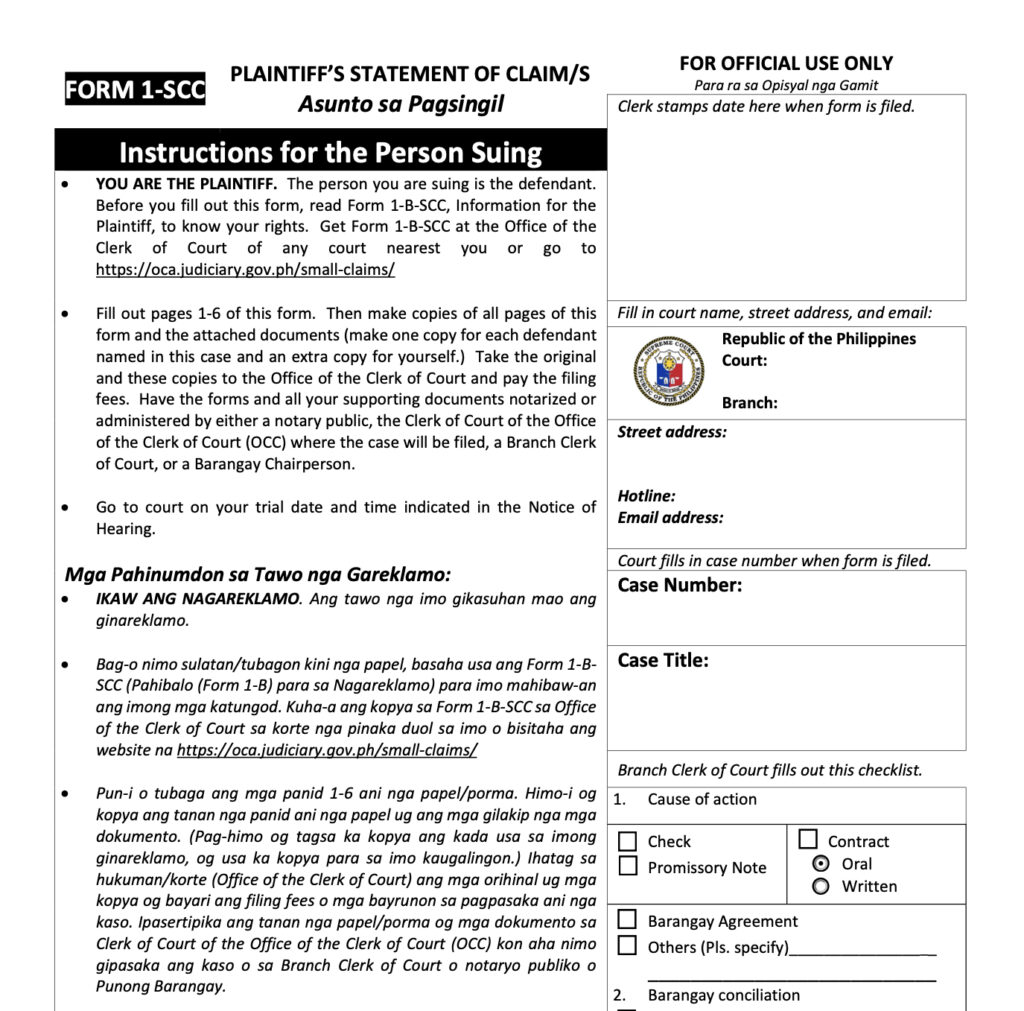
1. Drafting the Statement of Claim: Making sure the facts are airtight and legally sound so the judge doesn’t dismiss it on Day 1. You can always contact a lawyer to guide you in crafting the Statement of Claim Document.
2. Verification and Certification Against Forum Shopping, Splitting a Single Cause of Action, and Multiplicity of Suits (Form 1-SCC).
3. Two (2) duly certified photocopies of the actionable documents subject of the claim (e.g., contracts, promissory notes, receipts, bank deposit slips).
4. You must submit the affidavits of your witnesses. These must only state facts based on their direct personal knowledge or based on authentic records. (Rule IV Sec. 4)
5. Attachments/Exhibits: Other evidence to support the claim: Any other documentary or object evidence needed to prove your claim. But first, you must be able to discern: Which receipts, texts, and contracts actually matter? (Filtering out the noise).
- Note: No evidence will be allowed during the hearing if it was not attached to your Statement of Claim, unless you can show a good cause for its late admission.
- Tips: (1) Use the proper marking system Mark your documentary or object evidence as Exhibits A, B, C (and so on) if you are the plaintiff or complainant, and as Exhibits 1, 2, 3 (and so on) if you are the defendant or respondent.
- (2) When submitting electronic copies, save or print each annex as an individual PDF file separated from the main pleading/Statement to ensure that no small text will be rendered as hard-to-read. Use a strict filename format separated by hyphens: [Annex Designation]-[Pleading Title/Claim Statement Title]-[Case Number].pdf
- (3) Arrange exhibits chronologically.
- (4) Examples of Exhibits: (a) Promissory Notes, (b) Messenger chats where Defendant asked to borrow, received, or acknowledged the money; (c) Proof of Transfers: GCash, Bank Transfer, Palawan Padala, Cebuana/M Lhuillier Receipts or Emails; (d) Proof of demand such as Barangay Summons, Demand Letters, or chats.
To reiterate, make sure you have sent a Final Demand Letter before filing your Form 1-SCC.
6. Reproduce as many copies of the documents above as there are defendants.
7. Business declaration: You must explicitly state in the form whether you are engaged in the business of lending, banking, or similar activities, and state the exact number of small claims cases you have filed within the calendar year.
8. If the plaintiff is a juridical entity (like a corporation), you must attach a Board Resolution or Secretary’s Certificate authorizing the representative to file the claim.
9. No formal pleading is necessary.
10. Trial Coaching: A lawyer can give the client a “script” or bullet points on how to answer the judge confidently.
11. If you win the case, but the debtor still won’t pay, a lawyer may step back in to help file a Motion for Execution to seize assets.
Can a Filipino residing abroad (OFW) file a small claims case?
Yes, an Overseas Filipino Worker (OFW) or a Filipino residing abroad can file a small claims case in the Philippines.
While the rules generally mandate the personal appearance of parties during the scheduled hearing, an OFW who is physically unable to attend can be represented by another person, provided the following strict requirements are met:
- Valid Cause: The absence must be for a valid cause, such as physical inability to travel to the court due to residing abroad.
- No Lawyers Allowed: The authorized representative must not be a lawyer.
- Special Power of Attorney (SPA): The OFW must execute an SPA using the court-prescribed Form 7-SCC.
- Specific Powers Granted: The SPA must expressly authorize the representative to perform the following acts without further consultation from the plaintiff:
- Enter into an amicable settlement;
- Submit to alternative modes of dispute resolution; and
- Enter into stipulations or admissions of facts and of documentary exhibits.
Where to File (Venue): Since the regular rules on venue apply, the OFW can have the Statement of Claim/s filed in the First Level Court (Metropolitan Trial Court, Municipal Trial Court in Cities, Municipal Trial Court, or Municipal Circuit Trial Court) of the city or municipality where the defendant resides.
Step-by-Step Process to File Your Claim
Step 1: Gather evidence and send a Final Demand Letter
Step 2: Fill out the Verified Statement of Claim
Step 3: Pay docket fees at the Hall of Justice
Step 4: Attend the hearing
What happens next after a claimant (creditor) wins in a small case?
Once a claimant (plaintiff) wins in a small claims case, the decision is immediately final, executory, and unappealable. The claimant must take the following steps to enforce the collection:
1. File an Ex Parte Motion for Execution
You must file an ex parte Motion for Execution using the court-prescribed Form 12-SCC. Because it is an ex parte motion, you do not need to set it for a hearing or inform the other party beforehand.
2. Ensure Proof of Receipt is on Record
Before the court grants the motion, there must be proof on the court’s record that the losing party actually received a copy of the decision. Exception: If the decision was based on a compromise agreement between you and the defendant, proof of receipt is no longer necessary, and execution shall issue immediately upon motion.
3. Issuance of the Writ of Execution
Once the motion is granted, the court will issue a Writ of Execution (such as Form 13-SCC for a money judgment or Form 13-A-SCC if based on a compromise agreement) directed to the sheriff.
4. Enforcement by the Sheriff
The sheriff will implement the writ by demanding the immediate payment of the judgment obligation in cash, certified bank check, or any mode of payment acceptable to you.
- Levy: If the judgment obligor (debtor/respondent) cannot pay, the sheriff will levy upon their properties. The debtor has the option to choose which property will be levied upon first. If they do not choose, the sheriff will levy on their personal properties first, and if insufficient, their real properties.
- Garnishment: The sheriff may also garnish debts or credits belonging to the debtor, such as bank deposits (or payroll accounts). The garnished amount or a certified bank check will be delivered directly to you.
FAQs
Yes, a foreigner can file a small claims case in the Philippines.
There is no prohibition against foreigners filing a small claims case. Under the rules, any “individual” (defined as a natural person) or juridical entity authorized by law can be a party to a civil action. Therefore, as long as the foreigner has the legal capacity to sue and the claim falls under the coverage of small claims (i.e., purely civil in nature, solely for the payment or reimbursement of a sum of money not exceeding P1,000,000.00), they can initiate the action.
Here are the procedural details a foreigner must observe when filing:
Venue: The regular rules on venue apply to small claims. If the foreigner resides in the Philippines, they may file the claim in the court of the city or municipality where they reside or where the defendant resides, at their option. If the foreigner is a non-resident, the case must be filed where the defendant resides.
Personal Appearance and Representation: The rules generally mandate the personal appearance of the parties on the designated date of the hearing. However, if the foreigner is abroad or has a valid cause for physical inability to appear, they may appear through a representative.
Strict SPA Requirements: Similar to an Overseas Filipino Worker (OFW), the foreigner’s representative must not be a lawyer. The representative must be authorized through a specific Special Power of Attorney (Form 7-SCC) which explicitly grants them the power to enter into an amicable settlement, submit to alternative modes of dispute resolution, and make admissions or stipulations of facts and documents on behalf of the foreigner.
No, a formal demand letter is not strictly required before filing a small claims case.
However, you generally need to show that you asked the defendant to pay you before initiating the suit.
When you fill out the Statement of Claim form, you will be asked if you demanded payment prior to filing. The rules allow you to make this demand informally, such as in person or by phone, rather than strictly in writing. If you did not ask the defendant to pay before filing the case, you will be required to explain your reason to the court.
While a demand letter is not mandatory, attaching your latest written demand letter (along with proof of delivery and receipt) is highly recommended, as it is one of the recognized proofs of claim that will strongly support your case.
Yes, a small claims case requires a barangay certification (Certificate to File Action), but only if your dispute is covered by the Katarungang Pambarangay Law (KPL). If the law requires it and you fail to attach the certification, the court will dismiss your claim. You can skip Barangay Conciliation if: (a) either the plaintiff or the defendant is a juridical entity; (b) parties are outside the geographical coverage of the KPL; (c) If one party is the government or any of its subdivisions or instrumentalities.
Effect of Non-Compliance: The court may dismiss your Small Claims petition.
No, small claims cases do not require judicial affidavits.
The Judicial Affidavit Rule explicitly states that it does not apply to small claims cases.
Instead of the formal question-and-answer format required for a judicial affidavit, the Rules on Expedited Procedures for Small Claims merely require you to submit regular affidavits of your witnesses along with your Statement of Claim or Response.
These simple affidavits must state only facts based on the affiant’s direct personal knowledge or on authentic records admissible in evidence. Failure to submit these required affidavits, however, will cause the immediate dismissal of your claim or counterclaim.
If the defendant fails to file a verified Response and fails to appear at the hearing, the court will automatically proceed and render judgment within 24 hours based on the facts and evidence alleged in your Statement of Claim.
You can still file a criminal complaint. Filing a civil case (e.g., Small Claims) is not one of the enumerations of the law that will extinguish criminal liability. The primordial purpose of a civil action is for the resolution, indemnification, or reparation of the private offended party for the damage or injury he sustained by reason of the acts of the accused that constitute a delict or felony. (Ricarze vs. CA, G.R. 160451)
However, if a civil action is instituted before the criminal action, the pending civil action shall be suspended in whatever stage it may be found once the criminal action is commenced. It will remain suspended until a final judgment is rendered in the criminal action. (Rule 111 of the Revised Rules on Criminal Procedure) This also covers another case involving a prejudicial question.