
A Certificate of Land Ownership Award (CLOA) is a document establishing ownership of agricultural land granted or awarded to a qualified agrarian reform beneficiary under the Comprehensive Agrarian Reform Program (CARP). (Hence, this document is sometimes called “Award”)
Note: CLOA is not the same as a Public Land Patent.
In addition to proving ownership, a CLOA contains the restrictions and conditions of the grant. Common restrictions:
- The land cannot be sold, transferred, or conveyed for a period of 10 years; (Sec. 27, RA 6657)
- During this restrictive period, the only valid transfers are through hereditary succession, or to the government, the Land Bank of the Philippines (LBP), or other qualified agrarian reform beneficiaries; (Sec. 27, RA 6657)
Any sale or transfer to an ineligible person during this time is completely null and void. Additionally, beneficiaries are restricted from converting the agricultural land to non-agricultural use without prior approval from the Department of Agrarian Reform. Violating these restrictions can directly lead to the cancellation of the CLOA.
Complete Process
The process of transferring land from a private landowner to a qualified agrarian reform beneficiary under the Comprehensive Agrarian Reform Program (CARP) involves several strict legal steps.
Here is the start-to-finish process:
1. Identification and Notice of Coverage The Department of Agrarian Reform (DAR) first identifies the land, the landowner, and the potential beneficiaries. The DAR then sends a formal notice to the landowner by personal delivery or registered mail, offering to buy the land at a corresponding value. This notice is also posted in the municipal building and the local barangay hall (this is also known as Compulsory Acquisition Process).
2. Landowner’s Reply and Just Compensation The landowner has thirty (30) days from receiving the notice to inform the DAR if they accept or reject the offer.
- If accepted: The Land Bank of the Philippines (LBP) pays the landowner the purchase price within 30 days after the owner executes a deed of transfer and surrenders the original title.
- If rejected (or ignored): The DAR conducts summary administrative proceedings to determine the land’s just compensation. The LBP then deposits the compensation amount (in cash or bonds) into an accessible bank designated by the DAR.
3. Transfer to the Republic of the Philippines Once the landowner is paid or the compensation is deposited in the bank, the DAR takes immediate physical possession of the land. The DAR then requests the Register of Deeds to cancel the landowner’s title and issue a new Transfer Certificate of Title (TCT) under the name of the Republic of the Philippines.
4. Awarding the Land to the Beneficiary With the land now owned by the government, the DAR proceeds with the redistribution. The land is divided and awarded to qualified beneficiaries, with no individual receiving more than three (3) hectares.
5. Issuance and Registration of the CLOA The beneficiary is awarded a Certificate of Land Ownership Award (CLOA) or an Emancipation Patent, which serves as formal evidence of their ownership.
The DAR registers this CLOA with the Registry of Deeds, officially enrolling the property into the Torrens registration system. One year after this registration, the CLOA becomes indefeasible and imprescriptible, meaning it enjoys the exact same protections as a standard Torrens title.
6. Amortization Payments Ownership comes with responsibilities. The beneficiary is required to pay the Land Bank of the Philippines for the awarded land in thirty (30) annual amortizations at a six percent (6%) interest rate per annum. The Land Bank holds a mortgage lien on the property until it is fully paid.
Difference between Emancipation Patent vs. CLOA
An Emancipation Patent (EP) and a Certificate of Land Ownership Award (CLOA) are both land titles awarded by the Department of Agrarian Reform, but they differ in their legal basis and scope of coverage.
An Emancipation Patent is issued specifically pursuant to Presidential Decree No. 27 to tenant-farmers working on rice and corn lands. In contrast, a CLOA is issued under Republic Act No. 6657 (Comprehensive Agrarian Reform Law) to qualified farmer-beneficiaries for all other types of agricultural lands, regardless of the crop produced.
Despite these differences, both titles are registered in the name of the Republic of the Philippines and enrolled in the Torrens registration system and become indefeasible and imprescriptible one year after they are registered.
What should a beneficiary do so that he can legally sell the CLOA awarded land to any private person?
To legally sell CLOA-awarded land to any private individual, the beneficiary must meet two strict conditions: first, the 10-year prohibitory period from the date of the award must have passed, and second, they must have fully paid their 30-year amortizations to the Land Bank of the Philippines. To establish this, a prospective seller must secure a DAR Clearance (and, based on the writer’s experience, a clearance from the National Irrigation Commission).
Clearance also depends on the size of the land; usually, if the land is 5 hectares or below, the clearance is secured from the DAR Region. If above 5 hectares, from the DAR National Office (as per experience).
If the land is not yet fully paid, the beneficiary cannot sell it to just anyone; they are legally limited to transferring their rights only to an heir or another qualified agrarian reform beneficiary, and this requires prior approval from the Department of Agrarian Reform.
Qualified Beneficiaries (ARB – Agrarian Reform Beneficiaries)
To qualify as a CLOA beneficiary under the Comprehensive Agrarian Reform Program, a person must meet these core requirements (Sec. 22 RA 6657):
- Citizenship and Age: Must be a Filipino citizen and at least 15 years old at the time they are identified as a beneficiary.
- Landless Resident: Must be a resident of the barangay (or municipality) where the land is located and own less than three (3) hectares of agricultural land.
- Capability: Must be willing, able, and equipped with the aptitude to cultivate the land and make it productive.
When distributing the lands, the government follows a strict order of priority. Agricultural lessees and share tenants are first in line, followed by regular farmworkers, seasonal farmworkers, other farmworkers, actual tillers of public lands, their cooperatives, and finally, anyone else directly working on the land.
Indefeasibility of a CLOA
CLOAs are enrolled in the Torrens system of registration and are entitled to the same indefeasibility as regular certificates of title. Until it is duly cancelled in accordance with prescribed procedures, a CLOA remains valid, subsisting, and enjoys the same respect accorded to titles acquired through other modes.
Jurisdiction over Cancellation All cases involving the cancellation of CLOAs fall under the exclusive and original jurisdiction of the Secretary of the Department of Agrarian Reform (DAR).
Grounds for Cancellation
A CLOA may be legally cancelled if any of the following grounds are found:
- Exempted Land: The landholding is actually excluded or exempted from CARP coverage.
- Procedural Defects: Notices of coverage to the landowner were defectively or irregularly served, or there were errors in the identification of the landowner, landholding, or technical descriptions.
- Outside DAR Jurisdiction: The landholding falls under the exclusive authority of the Department of Environment and Natural Resources (DENR) or the National Commission on Indigenous Peoples (NCIP).
- Beneficiary Violations: The agrarian reform beneficiary committed any of the following offenses:
- Misused the land or misused/diverted financial and support services.
- Materially misrepresented their basic qualifications.
- Prematurely converted the awarded land into non-agricultural use.
- Sold, transferred, leased, or conveyed their right of ownership or use over the awarded land in violation of CARP provisions.
- Deliberately and absolutely failed to pay three (3) consecutive amortizations.
- Willfully and deliberately neglected or abandoned the awarded land.
I see Commonwealth Act 141, RA 782, and RA 3872 in my titles. Are these related to CLOA?
No, these specific laws are not directly part of the CARP (Comprehensive Agrarian Reform Program) or CLOA (Certificate of Land Ownership Award) framework.
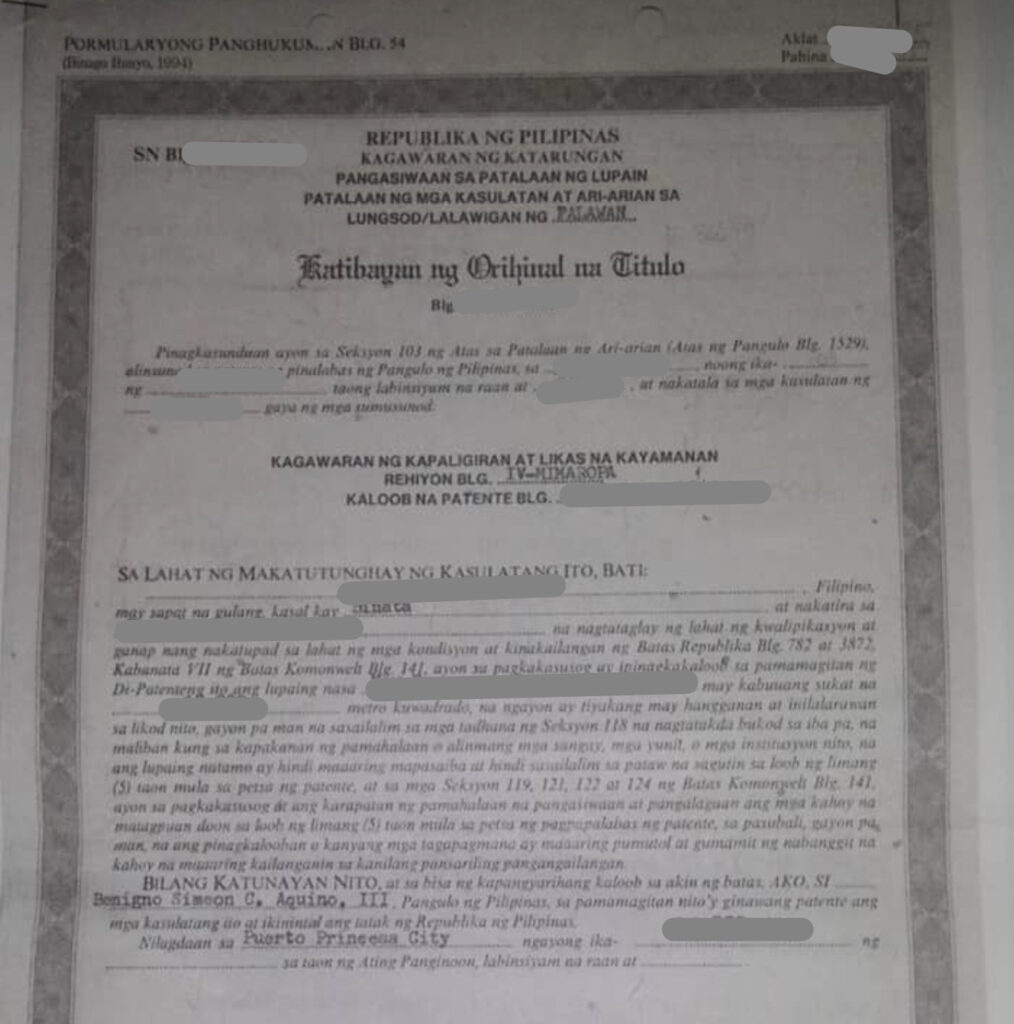
Here is exactly what these three laws do:
- Commonwealth Act No. 141 (CA 141): Known as The Public Land Act of 1936, this is the mother law governing how public lands in the Philippines are classified, surveyed, and distributed to citizens. If someone gets a “Free Patent” or a “Homestead Patent” from the government, it is derived from CA 141.
- Republic Act No. 782 (RA 782): Enacted in 1952, this law amended CA 141. It was passed to make it easier for ordinary citizens to secure titles, specifically granting Free Patents to people who had been continuously occupying and cultivating public agricultural lands since (or prior to) July 4, 1945.
- Republic Act No. 3872 (RA 3872): Passed in 1964, this law further amended CA 141. Its most notable feature was extending land rights to National Cultural Minorities (indigenous peoples). It gave them the right to apply for Free Patents over lands they had continuously occupied since July 4, 1955, giving indigenous groups a legal avenue to secure titles to their ancestral lands long before modern indigenous rights laws existed.
How They Differ from CARP and CLOA
While both systems exist to distribute land and empower Filipinos with property rights, they operate on two entirely different legal tracks, deal with different types of land, and are managed by different government agencies.
| Feature | Public Land Act (CA 141, RA 782, RA 3872) | CARP (RA 6657) |
| Primary Focus | Distributing unowned public lands to qualified occupants. | Redistributing already owned private and public agricultural lands to ensure social justice. |
| Administering Agency | Department of Environment and Natural Resources (DENR) | Department of Agrarian Reform (DAR) |
| Type of Title Issued | Original Certificate of Title (OCT) via Free Patent, Homestead Patent, or Sales Patent | Certificate of Land Ownership Award (CLOA) or Emancipation Patent (EP) |
| Target Beneficiaries | Long-term occupants and cultivators of public domain lands (including cultural minorities). | Landless tenant-farmers, farmworkers, and agricultural laborers. |
If a piece of land is awarded under CA 141, RA 782, or RA 3872, it is a Public Land Patent processed by the DENR. If a piece of land is awarded to a tenant-farmer under agrarian reform, it is a CLOA processed by the DAR.
FAQ
No, having “rights” to a property does not automatically mean they have a CLOA.
In the Philippines, when people say they only hold “rights” to a piece of land, it generally means they possess the property and have a claim of ownership, but the land is still untitled and not yet registered under the Torrens System. This is often evidenced merely by physical possession or Tax
Declarations, which only serve as provisional or presumed ownership.
A CLOA, on the other hand, is a specific formal document awarded to agrarian reform beneficiaries that is actually enrolled in the Torrens system of registration.
No, continuous payment of real property taxes does not automatically establish ownership.
Under Philippine law, tax declarations and tax receipts are not conclusive evidence of ownership.
While they are good indicators that a person is physically possessing the property in the concept of an owner, they cannot, by themselves, prove absolute ownership. (Heirs of Marquez v. Heirs of Hernandez 2022) This is especially true for properties covered by a CLOA, which is enrolled in the Torrens registration system; mere tax payments by someone else cannot defeat the actual registered certificate of title.
The best and most conclusive way to prove ownership of land awarded under a CLOA is by presenting the registered Certificate of Land Ownership Award itself.
Once a CLOA is registered with the Office of the Registry of Deeds, it is officially enrolled in the Torrens system of registration. Under the Torrens system, a certificate of title is the absolute best proof of ownership of a parcel of land. It serves as binding evidence of an indefeasible and incontrovertible title in favor of the specific person whose name appears on the document.
The law explicitly states that after one year from its registration, a CLOA becomes indefeasible and imprescriptible, affording it the exact same security and protection as any standard Torrens certificate of title. Because this registered title acts as conclusive proof, secondary documents like tax declarations, tax receipts, or unregistered deeds of transfer cannot defeat it.
No, the beneficiary cannot automatically sell the land just because 10 years have passed.
Even after the 10-year prohibitory period, the beneficiary can only freely sell the land to any private individual if they have fully paid their 30-year amortizations to the Land Bank of the Philippines. If the land is not yet fully paid, the beneficiary can still only sell or transfer their rights to an heir or to another qualified agrarian reform beneficiary, and they must first secure the approval of the Department of Agrarian Reform (DAR).
If a beneficiary fails to pay an aggregate of three annual amortizations, the Land Bank of the Philippines can foreclose the mortgage on the awarded land.
Once foreclosed, the Department of Agrarian Reform (DAR) will reallocate and award the forfeited landholding to other qualified beneficiaries. Additionally, the defaulting beneficiary is permanently disqualified from ever becoming a beneficiary under the agrarian reform program again.
If the heirs lost their owner’s duplicate copy of the CLOA, they must first execute an Affidavit of Loss and register it with the Register of Deeds of the province or city where the land is located. Next, they need to file a petition with the proper court for the issuance of a new owner’s duplicate certificate.
However, if the original CLOA title on file with the Register of Deeds was also lost or destroyed (for example, due to a fire or flood in the government office), the heirs must instead file a petition for “reconstitution” of the title to restore the record.