Quick answers:
- Litigants can legally change lawyers at any stage via a formal “Substitution of Counsel” (requiring the client’s signature, the former counsel’s conformity, and the new counsel’s entry of appearance).
- In the Philippines, Pre-Trial is the most critical stage of a civil case. It locks in the “stipulation of facts” and all documentary evidence.
- Generally, documents or witnesses not pre-marked or listed during the Pre-Trial Conference cannot be presented during the actual trial.
- Pre-Trial directly bridges into Court-Annexed Mediation (CAM), making it the primary venue for high-stakes financial settlements and Compromise Agreements.
- Hiring a dedicated private attorney before Pre-Trial allows for precise “If/Then” tactical planning, preventing fatal admissions on the court record.
Receiving a Notice of Pre-Trial in the mail and not knowing what to do gives much anxiety. Maybe you managed to file an Answer with the help of a free legal clinic, an IBP “LODi” (Legal Officer of the Day), or a busy lawyer friend.
You survived round one. But suddenly, there’s a specific date and time that you need to go to a courtroom. You’re looking at your current lawyer, and maybe you see they are “swamped” with cases. You may be asking yourself, “Is this really enough to protect my property?”
If you are losing sleep wondering if you are prepared for the legal battle next week, your emotions are perfectly valid. It’s perfectly normal to be concerned about your preparation.
Note that a Pre-trial Conference is not just a time to “meet and greet” the judge and the other parties. It is a crucial stage where 80% of civil cases are won, lost, or settled.
Why is Pre-Trial important and what happens there?
A pre-trial conference is a mandatory procedural device that focuses on simplifying and expediting the trial process, as well as stipulating the facts and annexes (Zaldivar v. People, G.R. No. 197056, March 2, 2016) or reaching for a possible settlement.
Its aim is to clarify the real factual and legal issues between the parties. It removes as many surprises and maneuvering as possible.
During this stage, lawyers are expected to fully disclose their positions on the real issues, which prevents them from embarrassing the court or injuring the opposing litigant through surprise tactics. (Permanent Concrete Products, Inc. vs. Teodoro, G.R. No. L-29766, November 29, 1968; Garayblas vs. Ong, G.R. Nos. 174507-30, August 3, 2011)
Its aim is a less cluttered trial.
Pre-trial is important because it allows parties to resolve or organize the following matters:
- It opens the possibility for the parties to enter into a compromise or submit to alternative modes of dispute resolution, such as mediation.
- It promotes the efficiency of the trial/proceedings by allowing the parties to “agree” (a.k.a. stipulate) on certain facts, thereby eliminating the need to present unnecessary proof at trial.
- It requires the parties to examine their respective documentary and object evidence and consequently pre-mark them.
- It allows parties to reserve evidence, including testimonial evidence, that is not available at the time of the pre-trial conference, subject to the limits provided for by the Rules.
- It limits the number of witnesses, identifies who will testify, and sets the specific trial dates.
- It allows the court to determine whether to render a judgment on the pleadings, enter a summary judgment, or dismiss the action outright if a valid ground exists.
- In criminal cases, it provides an avenue for the accused and the prosecutor to work out a mutually satisfactory disposition of the case, such as pleading guilty to a lesser offense, subject to the court’s approval.
Very important:
- If a document is not pre-marked during Pre-Trial, it generally cannot be used later. It’s best to ensure a lawyer doesn’t forget to mark a crucial receipt.
- During pre-trial, lawyers will ask the other party to admit an arranged set of facts. Here, paying close attention is crucial so that no admission or denial is made that could ruin the case.
- Admitting or denying a stipulated fact should not be done haphazardly. It requires anticipation of the other party’s moves. It must not be reactive but anticipatory. A lawyer must dedicate significant time to “foresee” several future possibilities of the admissions and denials.
- A lawyer must not only study what was raised by the opposing party, but also what was not raised. This is because a legal ground that is “missing” or “not raised” may hit-or-break your case. The counsel may need to step back and look at the “bird’s eye view” of your entire case to strengthen your chances of winning.
How Court-Annexed Mediation (CAM) Changes the Game
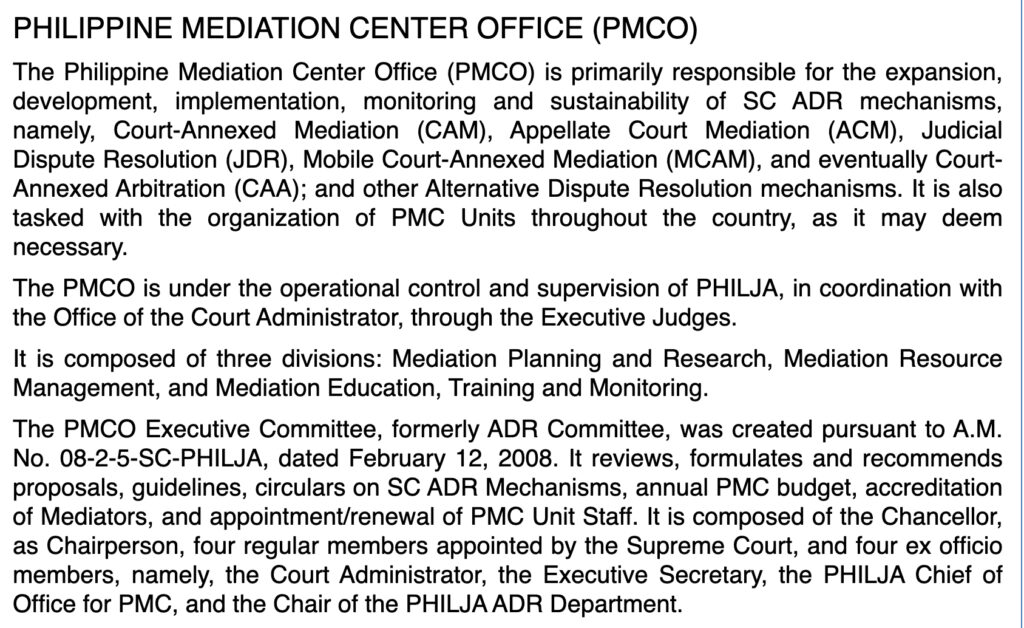
After pre-trial, the judge may refer the parties to Court-Annexed Mediation (a.k.a. CAM or simply “mediation”) which is held at the Philippine Mediation Center (PMC) (Halls of Justices usually have a dedicated room for PMC). Here’s its definition from the PHILJA website:
Timing, Duration, and Confidentiality
- When it is conducted: The court issues the Order of Referral to the PMC immediately after the pre-trial or preliminary conference, once the issues have been joined.
- Governing Law: Effective March 1, 2021, A.M. No. 19-10-20-SC, or the 2020 Guidelines for the Conduct of the Court-Annexed Mediation and Judicial Dispute Resolution in Civil Cases, now govern such proceedings.
- Strict Timeline: The mediation must be terminated within a non-extendible period of thirty (30) calendar days. During this period, court proceedings are generally suspended. (Salazar, The Fundamentals of Civil Procedure, 2021 Edition, p. 170)
- Confidentiality: All proceedings and discussions during CAM are strictly confidential
The CAM is where money settlement is usually negotiated. A lawyer knows how to use the skills of leverage, negotiation, and client correspondence in order to force a settlement and end the case years early.
A dedicated lawyer must be able to see the “if-and-thens” of settlement, such as the possibilities if a matter is not settled and proceeds to trial, and the threshold amounts that a client can reasonably absorb.